
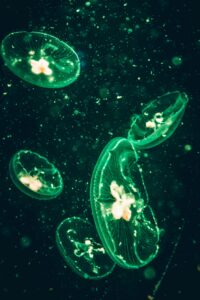
In 1962, marine biologist Osamu Shimomura decided to study the bioluminescent jellyfish Aequorea Victoria. This species, often called the crystal jelly, lives off the coast of North America and glows a bright green. Trying to understand the source of this light, Shimomura discovered Aequorin, a bioluminescent protein (but not a fluorescent protein) that emits a deep blue color. But jellyfish emit green light, not blue light.
He hypothesized that a separate compound was responsible for absorbing this blue light and re-emitting it as bright green light. Little did he know that the investigation of this substance would win him the Nobel prize and revolutionize cell biology.
This article explains the applications of fluorescent proteins in medicine.
Table of Contents
- What are fluorescent proteins?
- Seeing inside cells
- Tracking and understanding diseases
- Future applications in medicine
What are fluorescent proteins?
Shimomura named this other compound Green Fluorescent Protein or GFP. GFP is only one of a vast group of proteins that Biologists designate as fluorescent proteins. Fluorescent proteins absorb light at one wavelength and re-emit it at a longer wavelength, essentially glowing without dyes or other enzymes.
What’s interesting is that scientists have a huge supply of these proteins, and if they don’t, they can easily produce it in large quantities. This might seem contradictory to the fact that fluorescent proteins are found in nature, but in 1992, Douglas Prasher extracted from the jellyfish the gene that codes for the protein (not GFP itself) and actually stitched it into the genetic code of a bacteria called E. Coli. The E. coli then created many copies of the fluorescent protein.
Seeing inside cells
One application of these fluorescent proteins is to visually observe specific proteins in cells. To do this, scientists first clone the gene for a fluorescent protein like GFP and link it to the gene for a protein of interest. This creates a “combined gene” which basically is an instruction code for the cell to add a GFP to the protein when creating it. Then, scientists insert this gene into cells. The cell will create the protein with the GFP attached. Now, the scientist can shine blue light onto the cell. Since GFP absorbs blue light and reflects green light, the protein is labelled by the green light and the scientist can now detect it. Biologists use this to observe proteins as they move in real time such as in processes like mitosis.
Tracking and understanding diseases
But besides mitosis, Fluorescent proteins can also be used to understand diseases and how they spread. In animal models or lab grown human cells, scientists make tumors fluorescent to easily visualize them. When these tumor cells die, the fluorescence disappears, since normal cells do not glow.
This can be extremely useful to determine the effectiveness of treatment. Instead of having to wait until the observation of physical changes, scientists know that treatment was effective when the glow gets weaker and disappears. This also works for other diseases like infections (fluorescence indicates bacteria or viruses), or in genetic diseases (fluorescence indicates damaged cells).
Future applications in medicine
Similar to Green fluorescent protein, Scientists have created many variants (red, orange, yellow, blue) that absorb different wavelengths. But increased research is being dedicated to developing brighter and more stable ones, especially ones that emit light in the far red spectrum.
There is also research in the use of fluorescent proteins as an indicator of potentially conditions such as inflammation or metabolic changes. One recent experiment proposed to embed fluorescent proteins into a patch of skin so that when the body senses inflammation, the skin will turn green. This allows detection of disease in earlier stages, before symptoms are present.
A common theme in future proposals is to transition from animal models and lab grown cells to safe and effective human applications. This is where the core of the research lies. Integrating these technologies safely into clinical practices remains a significant goal. Nevertheless, the studies and experiments around these fluorescent proteins have the capability to foster significant advancement in all sorts of areas. What began as a glow in a jellyfish brightened the path to groundbreaking medical breakthroughs showing that even the smallest of questions can lead to the most rewarding answers.
Если собираетесь в Испанию, обязательно ознакомьтесь с тем, как добраться из аэропорта Мадрида в центр города – вариантов достаточно, от метро до автобусов и такси. Для тех, кто планирует посещение Канарских островов, полезно знать расположение на карте и что посмотреть, например, на Тенерифе или в Малаге за 1 день. Также советую изучить цены на продукты в Испании, включая Mercadona, чтобы лучше распланировать бюджет на 2025 год.
Для путешествующих по северу Испании интересны красивые города у моря и горнолыжные курорты, а для удобства в Валенсии стоит ознакомиться с системой общественного транспорта, билетами и тарифами, такими как karta suma walencja или metro walencja bilety. Подробнее о транспорте на Канарских островах и карнавалах можно узнать здесь [url=https://ispaniagid-top.ru/]valencia öffentliche verkehrsmittel[/url] . Надеюсь, эта информация поможет сделать вашу поездку комфортнее!
Если хотите провести в Венеции одни сутки, советую заранее создать маршрут по Венеции на 1 день с картой, чтобы осмотреть самые популярные достопримечательности. Например, обход пешком по Венеции на 1 день даст возможность пройти по площади Венеции, восхититься каналами и разузнать, сколько стоит совершить поездку на гондоле. Практичные рекомендации по маршрутам и ценам смотрите здесь [url=https://holidaygid4.ru]нюрнберг достопримечательности маршрут[/url] .
Кроме того, если вы планируете поездку по Италии и решили совместить поездку в Помпеи и Везувий или посетить Флоренцию за 1 день, важно рассмотреть маршруты и варианты транспорта заблаговременно. Аналогично, для тех, кто намерен отправиться по Германии, следует рассмотреть на достопримечательности Потсдама и берлинские маршруты, чтобы рационально спланировать время.
Если вы планируете использовать всего лишь один день в Венеции, рекомендую заблаговременно продумать маршрут пешком по каналам Венеции на 1 день, чтобы иметь возможность увидеть важнейшие точки интереса. Допустим, навигация по Венеции на 1 день с схемой упростит задачу найти дорогу и не сбиться с пути в дебрях маленьких улочек. День в Венеции — задача непростая, но абсолютно реальная, если разбираться, что увидеть в Венеции за 1 день, и сколько берут за прогулка на гондоле — расценки на гондолу колеблется, так что на кошелёк лучше смотреть заранее.
Путешественникам, кто намерен охватить и прочие города, советую добавить в маршрут жемчужину Тосканы: путеводитель по Флоренции на 1 день поможет осмотреть лучшие выставки и бутики, а к тому же открыть для себя, где поесть бюджетно во тосканской столице. Если планируется ещё больших впечатлений, можно организовать экскурсию по Доломитовым горам — поездка по Альпам на машине и как добраться туда часто обсуждаются на тематических форумах. Подробный маршрут и важные советы найдете здесь [url=https://holidaygid-italy.ru]венеция за 1 день: маршрут карта[/url] .
Если вы обдумываете маршрут для ходьбы по Калининграду на карте, старайтесь включить в свой план амалиенау — это район с великолепными улочками и особенной атмосферой, который легко осмотреть самостоятельно. Для людей влюблённых в природу интересны нетронутые пляжи Калининградской области, где получится насладиться спокойным отдыхом, но важно знать про время для купания и проверять, допустимо ли купание в море в Калининграде в нужный период. Развёрнутый маршрут по Калининграду с увлекательными точками и советами читайте здесь [url=https://kaliningradblog-gid.ru]температура воды на куршской косе[/url] .
Также советую посетить кафедральный собор Калининграда — там реально узнать немало занимательных фактов и услышать дневной органный концерт, который продолжается примерно час. Для тех кто предпочитает прогулки вечером, как провести вечер в Калининграде — задача несложная, здесь полно уютных мест с кафе и уютными переулками. Если вам интересно, как добраться до форта 11 Калининград на автобусе или на машине, а также что осмотреть в Правдинске или Черняховске — эти направления отлично подойдут для однодневных поездок.