Have you ever noticed that your phone dies faster during the winter?
The main reason for this is temperature. This may seem counterintuitive if you have studied basic physics, since cooling is often associated with reducing energy loss as heat. In many systems, lowering temperature can indeed improve energy efficiency by minimizing wasted heat. However, this principle does not always apply in the same way to batteries. Cooling must be applied under the right conditions—otherwise, it can actually reduce a battery’s performance rather than improve it.
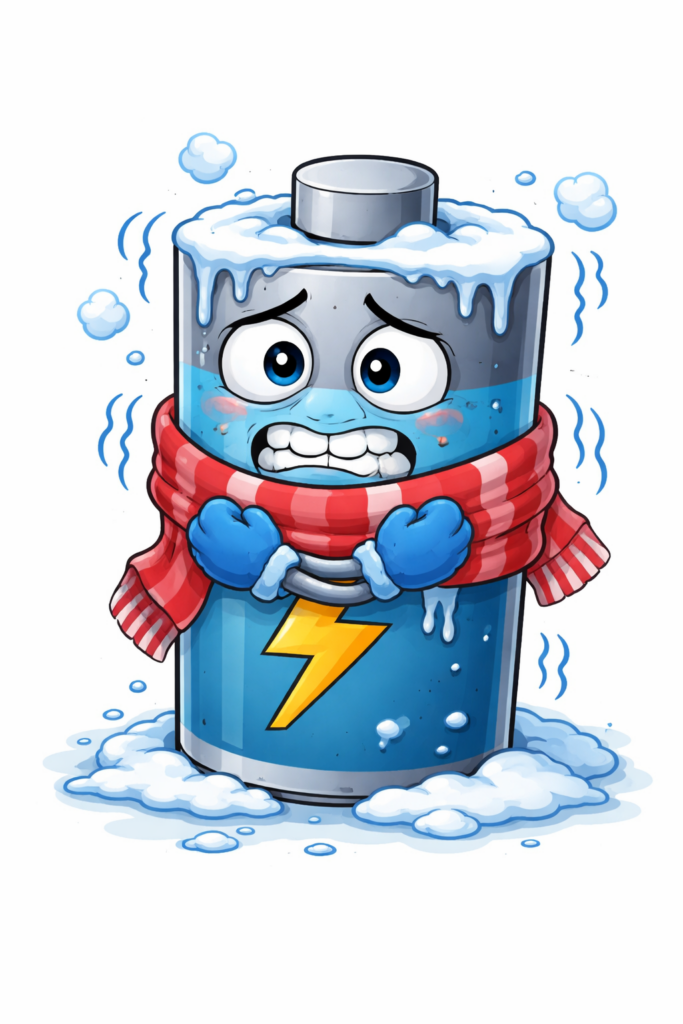
So why does low temperature make batteries seem to drain faster?
To understand this, we need to briefly examine how a lithium battery works. A lithium-ion battery generates electricity through the movement of lithium ions between two electrodes. When the battery is in use, these ions travel through a substance called the electrolyte, which enables the flow of electric charge and allows the battery to deliver power.
However, when the temperature drops, several changes occur inside the battery. First, the movement of lithium ions slows down significantly. Since the battery relies on this movement to produce electricity, a slower ion flow means that less energy can be delivered at any given moment. Second, low temperatures reduce the activity of the electrolyte, making it more difficult for ions to move freely. This increases the internal resistance of the battery, which further limits the flow of electrical energy.
As a result of these combined effects, the battery becomes less efficient at delivering power. Importantly, the battery is not actually “losing” its total stored energy; instead, a portion of that energy becomes temporarily inaccessible under cold conditions. This is why devices may suddenly shut down or show rapid drops in battery percentage in cold environments.

In conclusion, cold temperatures do not damage batteries immediately, but they do interfere with the chemical processes that allow them to function efficiently. This is why your phone—or even an electric vehicle—appears to lose battery life more quickly in winter.