In 1985, Kirk Noble Bloodsworth was convicted of first degree murder of nine year old girl Dawn Hamilton. He pleaded innocent but the Baltimore county court found him guilty and sentenced him to death. However, in 1993, forensic scientist Edward T. Blake famously proved that Bloodsworth was innocent of this crime through the use of DNA analysis.
Bloodsworth was only the first of 614 people who were wrongfully convicted and proven innocent through use of DNA. Scientists hail DNA profiling as a “eureka” moment in forensics, having been extremely effective in crime solving. Related technology such as Polymerase Chain Reaction has opened up gateways to many other potential DNA applications in fields such as healthcare, genomics, agriculture, virology , and many more.
Table of Contents
- What Is DNA and Why Is It Unique?
- Collecting DNA Evidence at Crime Scenes
- Analyzing DNA (Including PCR)
- Matching DNA: From Lab Results to Suspect
- Conclusion
What Is DNA and Why Is It Unique?
You can think of DNA as a sort of instruction manual. There’s a copy of it in each of your cells and each copy of it holds enough information to theoretically code for you in entirety. Since each cell holds a copy, DNA is present in hair, blood, saliva, bone, and teeth, which is just one of the many properties that make it useful in forensics.
DNA is also unique to everyone. No two people (barring identical twins in rare instances) share the same DNA. However, every person has only 0.01% of a difference in their DNA compared to others; 99.99% is the exact same in every human. The DNA code is sort of like a really long collection of books (23 to be precise), each written with a four letter alphabet. Picture 4 different types of molecules all in one long chain. Scientists call these 4 molecules “A, T, C, and G”. So between different people, only few of the letters are different.
But some parts of the DNA don’t actually code for you. Introns are non-essential words in the “book” that get cut out when the cell reads the instructions to code you (although they do serve a purpose). There are specific parts of introns called STR regions, which are used in forensics. These STR regions are special because they fall into the 0.01% of DNA that differs between people. STR stands for Short Tandem Repeats because they are usually a randomly repeating sequence of the four letters. For example, in a specific STR region, one person might have AGAT repeated 5 times, but another person might have AGAT repeated 6 times, or a completely different Short Tandem Repeat.
Now that we have the necessary background information about DNA and the properties that make it so useful in forensics, let’s go through the process of forensic DNA analysis step by step.
1. Collecting DNA evidence at crime scenes
It all starts with the evidence. Since DNA is present in every cell, the first step is usually to collect biological material. This can be hair, blood, or saliva samples.
2. Analyzing Data
This next step is twofold. First the examiner must isolate DNA from the sample. This is done using chemical methods like Chelex or silica columns. Then, after the DNA is extracted, a process called Polymerase Chain Reaction allows scientists to create millions of copies of specific DNA segments (usually STR regions). From these copies, scientists create a DNA Profile to better visualize these segments. Each segment of DNA appears as a “band” that analysts labele with a fluorescent dye or primer for better identification.
This is done using a technique called gel electrophoresis, which essentially uses an electric field to separate different sections of DNA. The resulting DNA profile is unique to each individual, meaning if two DNA profiles match, they are from the same person.
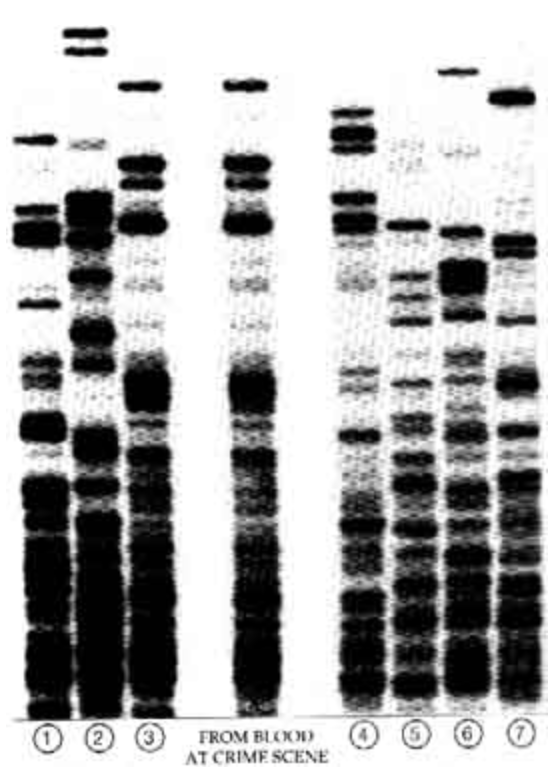
Image of DNA profile
Matching DNA: From Lab Results to Suspects
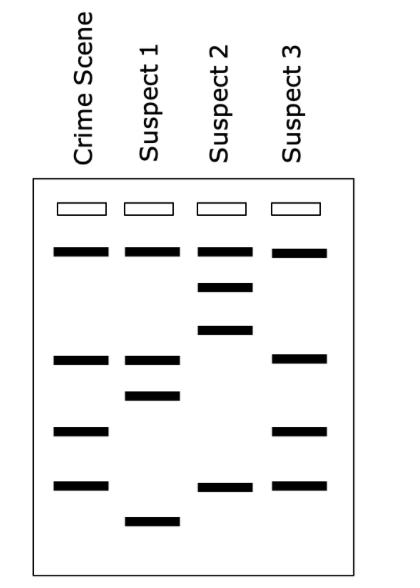
Scientists then compare the DNA Profile from crime scene evidence to DNA profiles from other suspects. They also compare the crime scene profile to preexisting profiles in databases like CODIS (combined DNA index system). In Bloodsworth’s case, his DNA profile didn’t match the crime scene profile, proving his innocence.
Conclusion
Advancements in forensic technology constitute an essential step forward, making the world a safer place. What was initially a simple experiment worked its way into the criminal justice system, becoming an integral part of forensics. Since then, many further innovations have built on this concept, and each step we take serves to further distinguish the line between fiction and reality.