
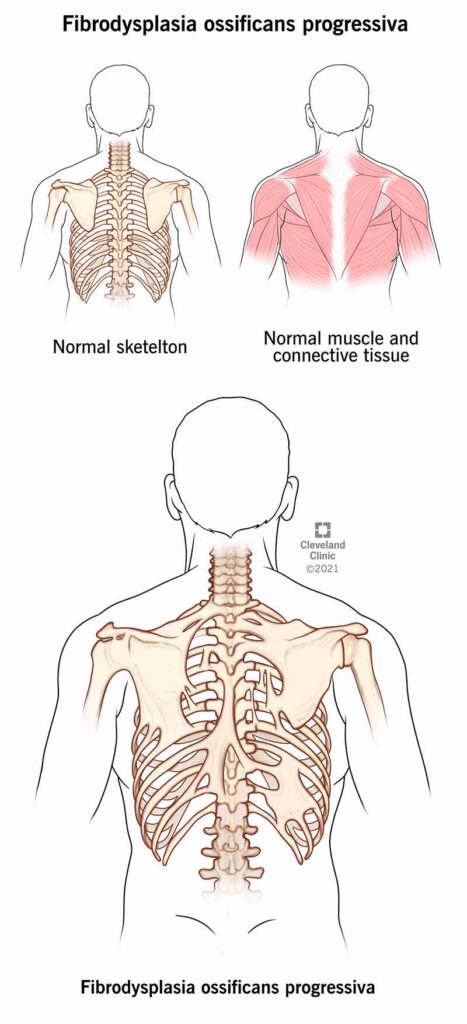
Fibrodysplasia Ossificans Progressiva (FOP) is commonly known as Stoneman Syndrome. It is a rare genetic disorder in which connective tissue and muscle are gradually replaced by bone. Although this may sound like something out of a TV show, this is very real.
Table of Contents
- What is Stoneman Syndrome?
- What is the cause of Stoneman syndrome?
- What is the Treatment?
- What are the Symptoms?
- Conclusion
What is Stoneman Syndrome?
In 1962, Guy Patin described a patient who showed signs of FOP. Dr. Victor McKusick studied at Johns Hopkins University School of Medicine, and he is often referred to as the father of medical genetics. He officially named the disorder Fibrodysplasia Ossificans Progressiva. Stoneman Syndrome causes a person’s connective and muscle tissue to turn into bone gradually. This extra bone, known as heterotopic bone, forms outside the normal skeleton and can severely limit movement.
What is the cause of Stoneman Syndrome?
Stoneman Syndrome is a rare genetic disorder. A mutation of a specific gene causes it. This mutation occurs when an error occurs during cell division, which can damage the genetic material. As a result, the body begins to turn soft tissues like muscles and ligaments into bone—a condition known as Fibrodysplasia Ossificans Progressiva (FOP).
What is the Treatment?
Doctors use treatments for Stoneman Syndrome to help reduce symptoms. Although no formal cure exists, researchers continue to make progress through clinical trials, helping more people receive earlier and more accurate diagnoses.
- Participating in occupational therapy
- Taking antibiotic medications
- Wearing a supportive brace
- Using mobility aids, such as a wheelchair
What are the Symptoms?
The main symptom is the transformation of connective and muscle tissue to bone. Most of the time starts in the shoulders and neck in adolescence.
One symptom that leads to the diagnosis is a malformed or short big toe that can sometimes grow over or inward toward the second toe.
Conclusion
Stoneman Syndrome, also known as Fibrodysplasia Ossificans Progressiva (FOP), is a rare genetic disorder that causes connective and muscle tissue to turn into bone gradually. This abnormal bone growth severely limits movement. Experts estimate that FOP affects about 1 in 2 million people. Doctors often identify the condition by a key trait—a malformed big toe present from birth. While there is no cure, doctors focus treatment on relieving symptoms and improving the person’s quality of life.
FOP may be an extremely rare disorder; however, learning about it reminds us of the value of medical research and the importance of supporting those living with misunderstood conditions.

qqh803