Contrary to common belief, protons, neutrons and electrons that make up atoms – subatomic particles. Are not the smallest particles that are found; instead, they get even smaller. There are smaller particles called elementary particles, which are the building blocks of the universe.

What are Elementary particles?
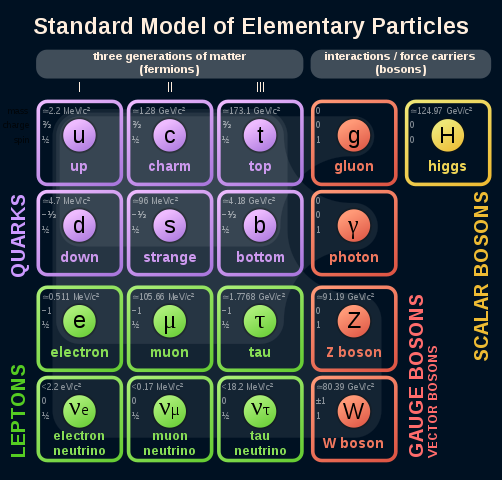
Elementary particles are particles that are not known to be made up of any smaller component particles. They are considered the basic building blocks of matter and are not composed of any other smaller particles. There are three groups of elementary particles called: quarks, leptons and bosons.
Physicists organise these particles into something called the Standard Model. Which is something like a periodic table for the elementary particles.
The Standard Model is broken into three families
- Quarks
- Leptons
- Bosons
Quarks
Quarks are fundamental particles that are never found in isolation; they are always found in combinations of 2 or 3 quarks. They are held together by a strong force, forming what are called hadrons. For example, protons and neutrons are made up of quarks. There are 6 different “flavours” or types of quarks (each of them has a fractional charge):
- up
- Charm
- Top
- These three have a fractional charge of +2/3e
- Down
- Strange
- Bottom
- These three have a fractional charge of -1/3e
Leptons
Leptons are one of the two fundamental building blocks of all matter, along with quarks. There are six types of leptons: the electron, muon, tau, and their corresponding neutrinos, which barely interact with matter. Billions pass through you every second without you noticing.
Bosons
Bosons, also known as force carriers that are separated into the following force carriers:
- photons– Carry electronic charge
- Gluon – The force that binds quarks together
- Gravitons– theorised to carry gravity (not yet proven)
- Higgs boson – gives mass to particles
- W and Z bosons – control the weak nuclear force (responsible for radioactive decay)
WHY THEY MATTER
Elementary particles aren’t just abstract science — they explain why matter exists, how stars burn, and how the universe evolved after the Big Bang. The search for new particles could even reveal what dark matter is made of.
The Quest Continues
- From giant particle accelerators like the Large Hadron Collider to deep-space observatories, scientists are still uncovering the secrets of the subatomic world. Every discovery brings us closer to answering one of humanity’s biggest questions: What is everything made of?
- With the arrival of AI, the way that we understand and study elementary particles that form and mould our entire universe is continuing to change drastically.
- AI is allowing scientists to tackle our lack of understanding of the universe differently, focusing on open-ended questions about the data instead of only searching for specific patterns. This new approach is helping physicists uncover unexpected phenomena that may unlock breakthroughs in understanding the universe’s fundamental forces.
Fun fact
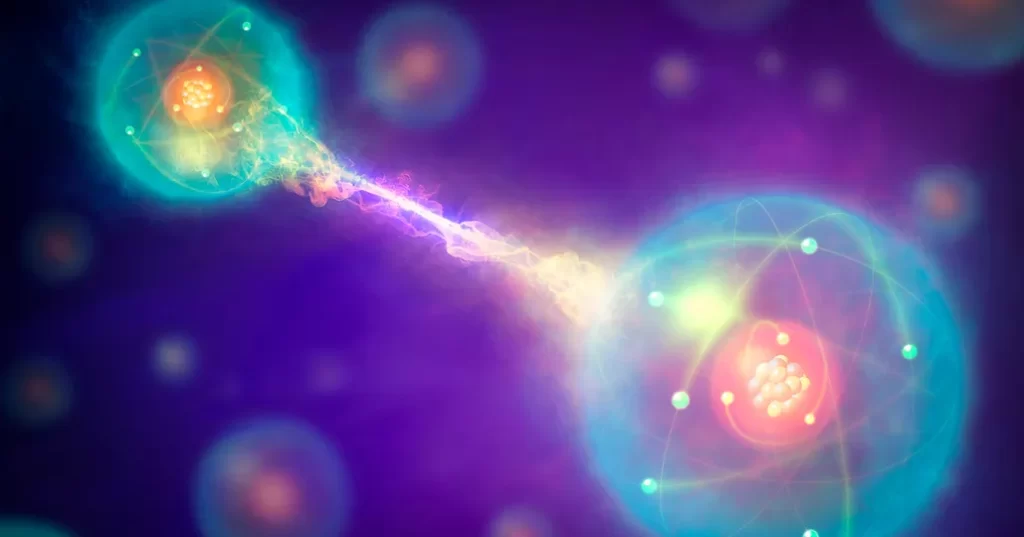
If the nucleus of an atom were the size of a pea, the electrons would be orbiting more than 200 meters away therefore, most of matter is empty space!
Special Note from the Author of the Article
Our Understanding of the universe is vastly increasing, and our constant pursuit of knowledge is allowing us to gain a deeper understanding of our universe and the numerous opportunities that are available. Remember, the future is only as large as we make it.