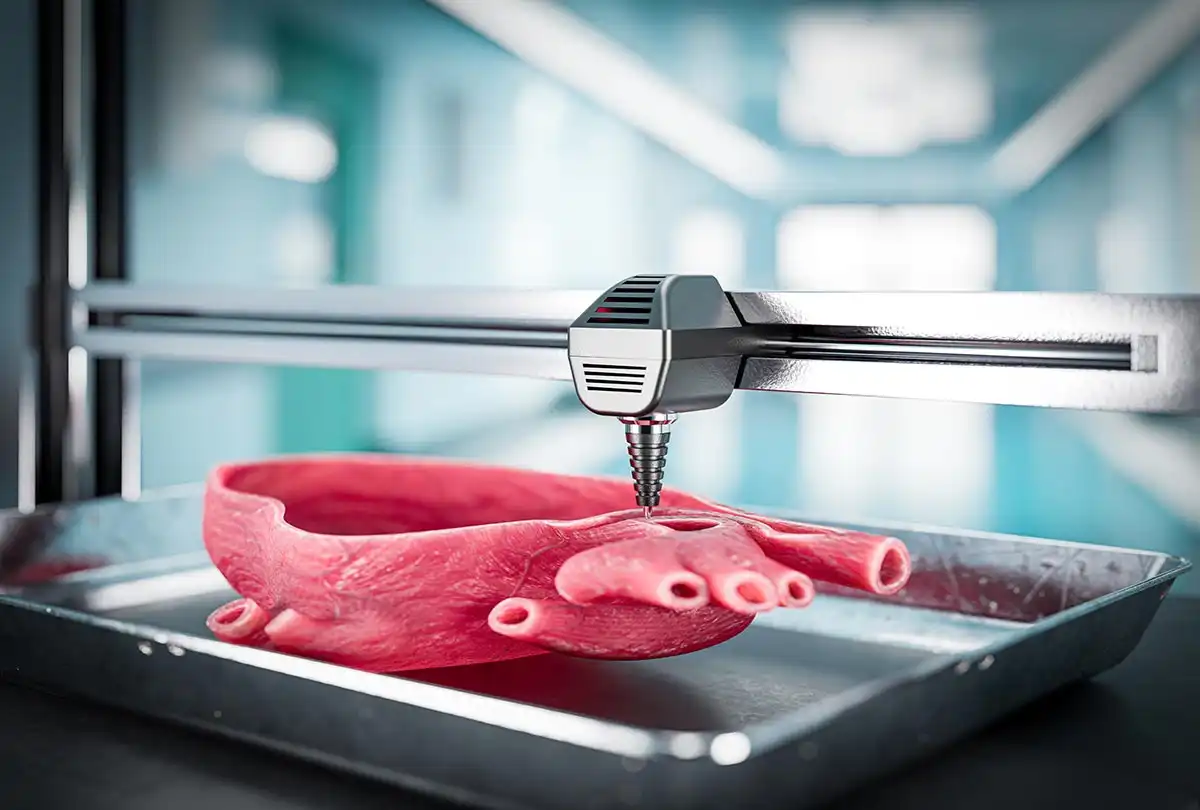
As technology advances, the medical field has expanded rapidly as well. Technology has drastically changed how our medical system operates from newfound treatments to advanced procedures. One new piece of biomedical engineering which is on the rise in the healthcare industry is bioprinting which allows for the 3D printing of tissue matter that functions very similar to the organs and matter inside humans. This revolutionary technology has many different purposes and a fascinating process behind it that could change the entire medical field.
Table of Contents:
- What Is it Used for?
- How the Process Works
- Before the Print
- The Different Methods
- Final Steps
- Conclusion
What Is it Used for?
Bioprinting can be used to assist with a myriad of tasks and problems. One example is surgical modeling. By having a physical replica of the tissues or organs, surgeons are able to physically practice their skill and tasks in a low-risk environment. These alive tissues also allow for researchers and pharmaceutical companies to test their drugs. The fabricated tissues and organs respond to drugs and medicine in the same way as a human version of that same tissue allowing those companies to test drugs without potentially harming living humans and patients. However, the final goal of bioprinting is to solve the issue of the constant shortage of donor organs. Bioprinted cells could replace the need for other human donor cells or organs, providing a solution for the long waits for a replacement kidney or liver.
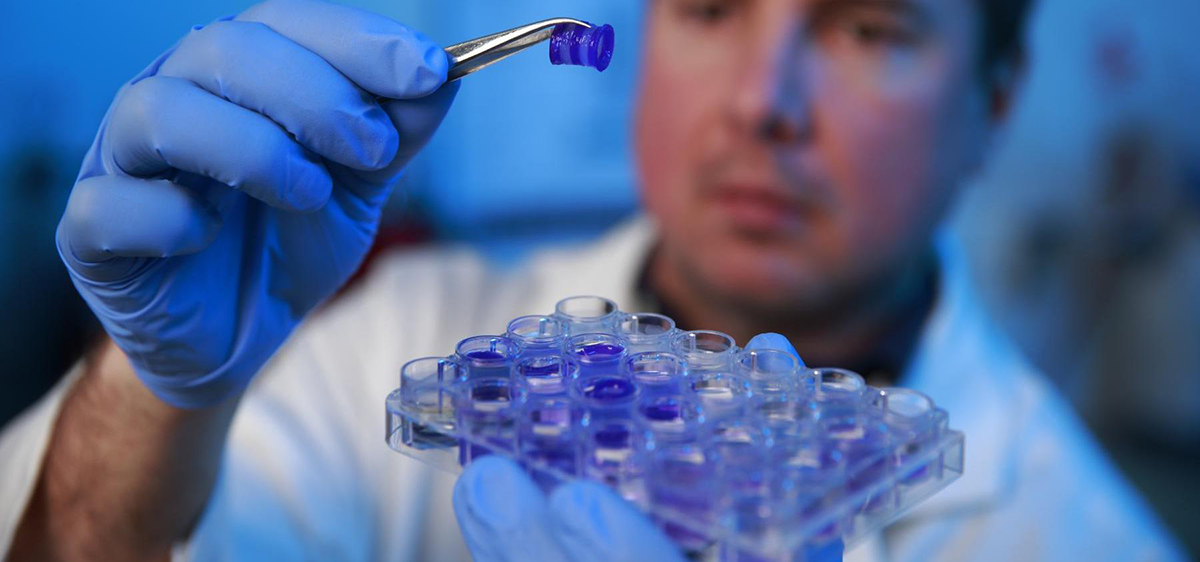
A researcher testing on 3d printed human tissue
How the Process Works
Before the Print
But how does the actual process work? At its core, bioprinting is essentially depositing biological material to form biological tissues. This process is very similar to 3d printing but instead of cartridge ink, they use semi-liquids called bioinks. These fluids are usually made up of a person’s own cells and other nutrients like collagen which provide structural support. By providing structural support, the extra molecules are able to make sure that the fragile cells survive the printing process and are able to stay in shape. Before the printing starts and any bioink is used, a digital file needs to be created for the printer to read. The software allows researchers to design 3D geometries and models which determines the shape of the final product.
The Different Methods
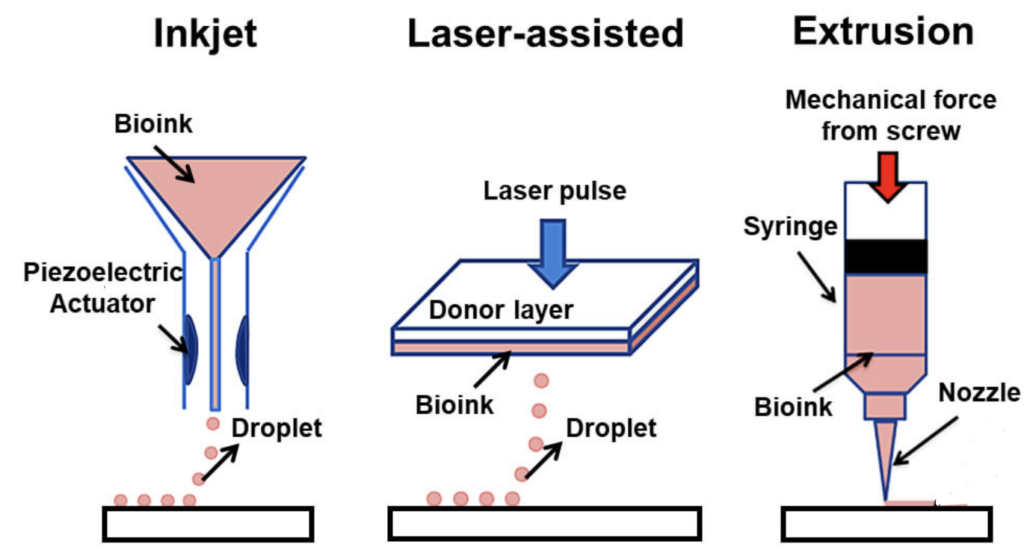
For the actual printing process, there are three main types of bioprinting: Extrusion-Based Bioprinting (EBB), Inkjet-based Bioprinting (IBB), and Laser-Assisted Bioprinting (LAB). EBB is the most common and pushes the bioink out of a nozzle using pressure and creates solid layers that stack to form the desired tissue. While this is highly versatile and can create thick strong structures, the stress during the printing process can damage cells and reduce their viability. IBB is a droplet-based process and fires microscopic droplets using thermal or piezoelectric (charge stored by objects as a result of pressure) energy. While originally only used for 2d printing, researchers were able to modify the process to fit a 3d use. However, since the bioink has to be in a highly liquidated state, inkjet bioprinting is quite limited in creating rigid structures. Lastly, LAB actually has no contact and uses a laser as the source of energy. The laser’s high energy induces a forward transfer of the biomaterials onto a solid surface. However, this is the most costly, keeping it from becoming as widespread among bioengineers.
Final Steps
After the printing process is over, researchers need to crosslink the structure to keep it stable. Crosslinking binds liquid polymer chains to each other creating a solid, gel-like structure. This is usually done by treating the constructed product with ionic solution or UV light. Then, the engineers keep the product in an incubator for cultivation eventually.
Conclusion
Despite this long and exhaustive process, the final product is well worth it. The 3d printed tissue or structure can be used for a variety of purposes that can each help advance the medical field and make hospitals and drugs safer. Eventually, they can replace donor organs and make vital contributions to patients in need. Bioprinting is just the tip of the iceberg of technological advancements that are rapidly evolving the healthcare industry. Keep your eyes open everyday because a new revolutionary equipment could appear in the very near future!