Playing is a common sight across numerous species. It’s evident in the pair of bear cubs tumbling down a riverbank, or a kitten pouncing on a loose thread, or a pod of dolphins riding the waves of a ship. But beneath the surface of this phenomenon lies a scientific puzzle. In the wild, where energy is precious and every moment can mean the difference between life and death, why would evolution allow for something as seemingly “wasteful” as play? That’s because what looks like simple fun is actually a crucial form of training for the complexities of life, one with lessons we are only just beginning to understand. From building a better brain to navigating the complicated rules of society, play is nature’s ultimate classroom.
Table of Contents
- What is playing?
- What are the known benefits of playing?
- What do we not know about playing?
What is playing?

Play can be outlined as “repeated, seemingly non-functional behavior differing from more adaptive versions structurally, contextually, or developmentally, and initiated when the animal is in a relaxed, unstimulating, or low stress setting”. Together, these criteria distinguish play from practice, foraging, or aggression and allow recognition beyond mammals to birds, reptiles, fishes, and invertebrates.
It most likely evolved from multiple origins and appears patchily across taxa (mammals, birds, reptiles, fishes, invertebrates). A widely used framework distinguishes three process levels:
- Primary processes: Play comes from baseline factors (extra energy, boredom, lowered thresholds, mild motivational conflicts) without direct fitness benefits, but generates behavioral variability for selection to act on.
- Secondary processes: Play maintains and helps with developing physiological and behavioral systems (like coordination, socio-cognitive scaffolding).
- Tertiary processes: Play supports flexible, innovative skill sets such as broader problem solving, coping with unpredictability, and creative combinations of behaviors.
What are the known benefits of playing?
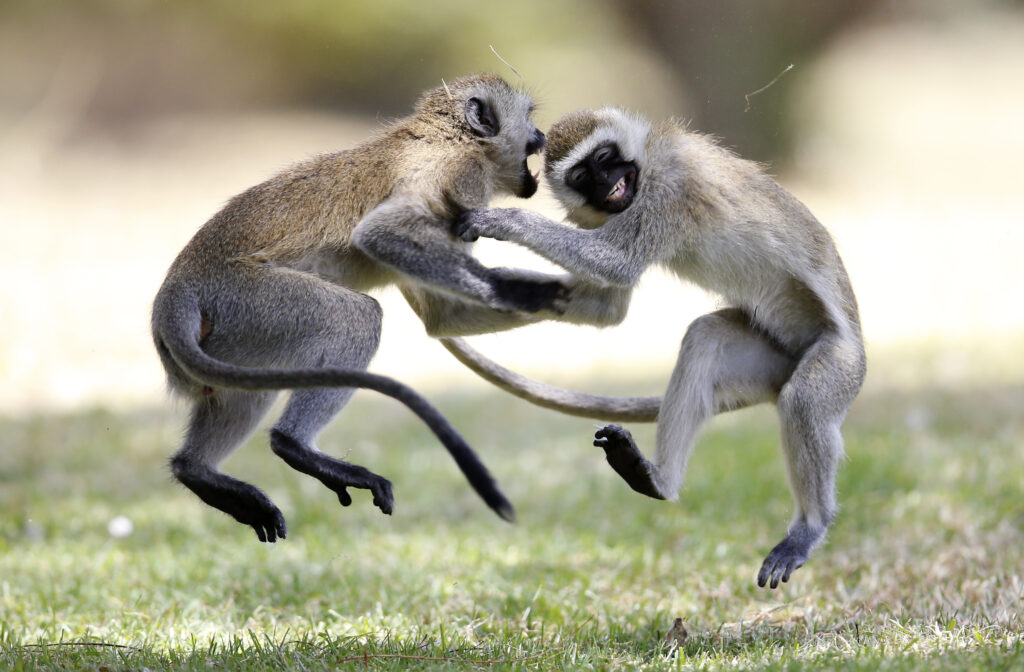
Play is important because it impacts multiple layers of welfare, brain function, and social life across species. As a welfare indicator, play often declines when animals face threats (food scarcity, predation risk, illness), and it typically emerges in relatively safe, low-urgency contexts. However, it’s not a simple as “good equals more play”. Play can rebound after deprivation, or rise with reduced parental care, or appear under mild stress, so its interpretation must be contextual.
Play also engages reward systems. In mammals (especially rats), social play taps the brain’s motivational circuitry. Dopamine is a chemical messenger that “acts on areas of the brain to give you feelings of pleasure, satisfaction and motivation”. In this case, dopamine shapes the “wanting” to play, while something known as the mu-opioid activity in the nucleus accumbens contributes to “liking,” the pleasurable aspect. These systems help explain both the drive to play and the contagious spread of playful mood within groups.
Play can deliver immediate psychological and social benefits. Even when it doesn’t train specific adult skills, it can enhance emotional regulation, reduce tension, and build social familiarity—effects seen in tolerant species (like bonobos) where adult-adult play helps negotiate relationships and smooth conflict around resources. In practical welfare contexts, promoting opportunities for play can reduce stress and improve group dynamics. It can also help the brain to learn how to deal with uncertainties and how to adapt. Research shows that when young rats lack playmates, their prefrontal cortex develops poorly, impairing social decision-making. They also exhibit weaker short-term memory, reduced impulse control, and difficulty recognizing or responding to other rats’ threatening signals.
What do we not know about playing?
The problem is there is a lack of consensus on most of the research done on play. The information mentioned above is generally accepted; however, many others are still being explored. For example, the mechanisms that drive non-social play or how reward circuits vary across taxa, remains unresolved. Similarly, the benefits and costs of adult play are not well quantified or generalizable across species.
Still, there are ways forward: use shared, cross-species datasets and simple, standardized measures of play; run longer, preregistered studies to track real-world outcomes; and pair careful behavior tracking with basic brain tools to separate motivation from pleasure. Add in lightweight computer models to test ideas before fieldwork, plus open collaborations between zoos, labs, and video archives, and we can turn confusion into clear, testable answers.