
Cat whiskers look like cute, stiff hairs but are actually powerful sensors called vibrissae that work as detectors, measuring tapes, navigation guides, body balancers, social signals, and protectors. These amazing features give cats a super sense of the world for hunting, moving, and staying safe, so never trim or pluck them—protect these natural marvels instead…
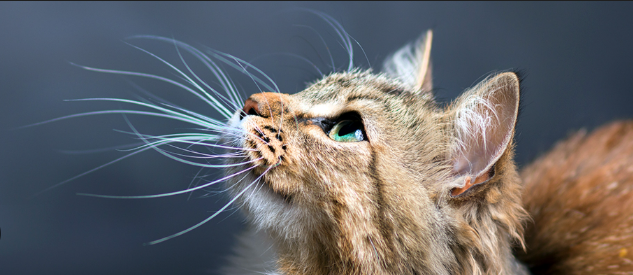
Cat whiskers are often viewed as a symbol of cats, as well as of their eyes and ears. They are long, thin, stiff, yet flexible. They look clearly different from mere furs. Unlike mere furs, they grow in half a year, and their damage can lead to broken cats. We know that there is something “special” about those whiskers, but nobody knows what they really do. Are they really exist only to show off their cuteness? What are those whiskers, and what would they actually do?
Table of Contents:
- The Actual Name
- Anatomy behind Whiskers
- 6 Functions
- Detectors
- Built-In Measuring Tapes
- Navigation Guides
- Body Balancers
- Social Signs
- Feline Bodyguards.
- Conclusion
The Actual Name
The scientific name for cat whiskers is vibrissae, while its singular form is vibrissa. They are any of the stiff hairs that are located on the face and especially about the snout of many mammals and typically serve as tactile organs, or a similar stiff tactile hair growing elsewhere on some mammals (as in a small tuft at the wrist). But other than this meaning, there are also definition for nose hairs and birds’ feathers near the mouth. This fancy word, vibrissae is unsurprisingly originated from the Latin word vibrare, meaning “to vibrate” or “to move rapidly back and forth”. This origin reflects their function very well, knowing that they allow animals to detect subtle movement and changes in their environment.
Anatomy behind Whiskers
These fantastic vibrissae have distinctive structure to perform unique functions. Rooted deep down into hypodermis where is B3 floor of the surface of animals’ skin, each vibrissae follicle has 100-200 nerve fibers compared to regular hair follicles that has only 2-3 nerves.
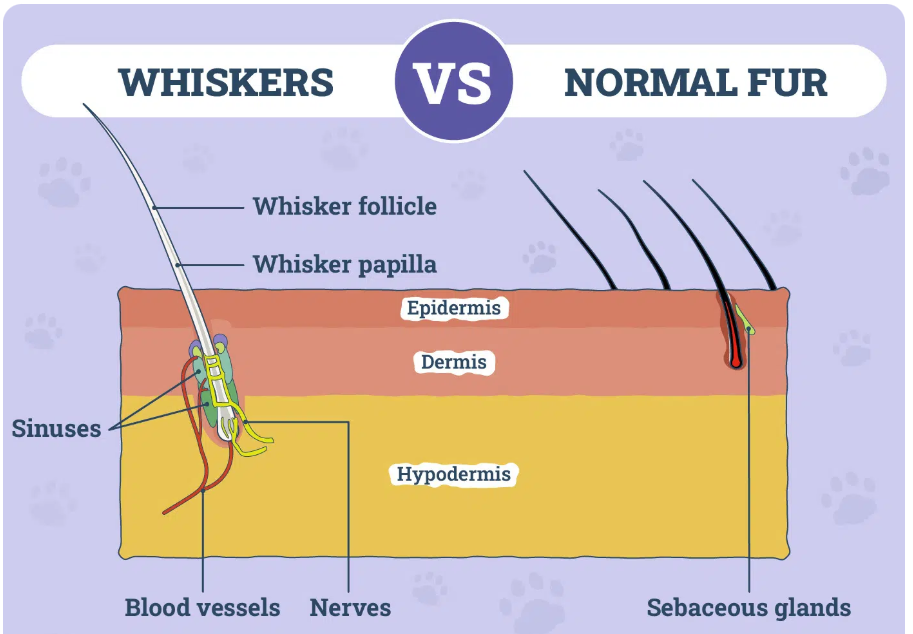
These highly sensitive structures are located not only near cats’ mouths but also above their eyes, on the chin area, and on the backs of their front legs. Here is a table showing locations of whiskers alongside with the number, function, and length:
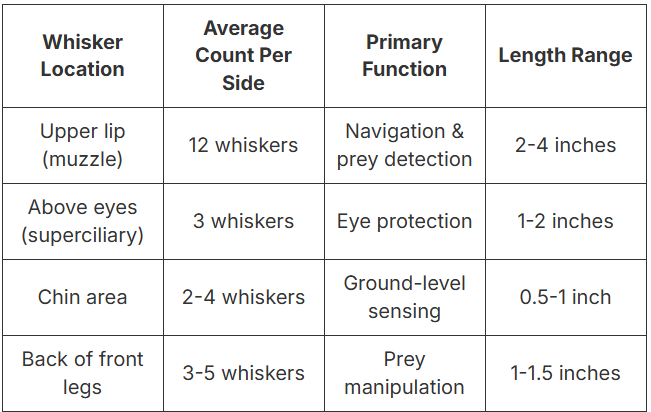
Overall, in total typically ranges from 40-50 individual whiskers when counting all locations.
6 Functions
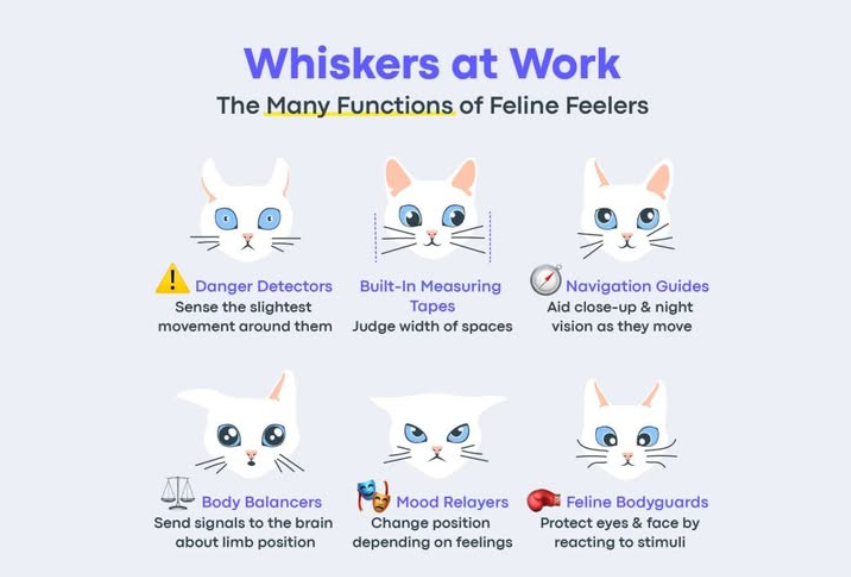
Fully utilizing vibrissae, cats were successfully able to use them as 6 things: Detectors, Built-In Measuring Tapes, Navigation Guides, Body Balancers, Social Signs, Feline Bodyguards.
Detectors
First, cat whiskers function as highly sensitive motion and danger detectors. They pick up the slightest shifts in air currents and vibrations caused by moving objects, prey, predators, or even subtle environmental changes. This allows cats to detect approaching threats or opportunities (like a mouse scurrying nearby) without relying on sight—especially useful at night or in tight spaces. The nerves at the base of the whiskers send rapid signals to the brain, acting like built-in radar.
Built-In Measuring Tapes
Second, they serve as a natural measuring tool for spatial awareness. They are typically about as wide as the cat’s body (muzzle whiskers span roughly the cat’s widest point). As the cat approaches a gap, opening, or tight space, the whiskers brush against surfaces or detect changes in airflow, instantly telling the cat whether it can squeeze through without getting stuck. This prevents awkward jams in fences, furniture, or boxes.
Navigation Guides
Third, they act as navigation guides, especially in low light or complete darkness. Cats have relatively poor close-up vision and are crepuscular (most active at dawn/dusk), so whiskers help them map nearby objects, judge distances, avoid obstacles, and move confidently. They detect air disturbances and physical contact ahead of the face or body, functioning almost like a tactile GPS. Even blind cats rely heavily on them for safe movement, climbing, and jumping.
Body Balancers
Fourth, they contribute to body balance through special sensory organs called proprioceptors (located at the whisker base or tip in popular descriptions). These send constant feedback to the brain about the cat’s body position, limb orientation, and movement in space. This helps with precise coordination during jumps, turns, falls, and the famous “righting reflex” (landing on their feet). Trimming or damaging whiskers can temporarily disrupt this sense of balance.
Social Signs
Fifth, they serve as social signs or emotional barometers. Cats actively move their whiskers to communicate mood and intentions to other cats (and observant humans). For example:
- Whiskers relaxed and spread out → calm and content.
- Whiskers pulled back flat against the face → scared, angry, or defensive.
- Whiskers pushed forward → curious, excited, hunting, or alert.
This positioning is part of feline body language and helps in social interactions, play, or conflict avoidance.
Feline Bodyguards
Lastly, they function as feline bodyguards by providing protective alerts. The whiskers above the eyes (supraorbital) and on the muzzle act like early-warning shields: the slightest touch from dust, debris, grass, or a potential hazard triggers an instant blink or head shake to protect the eyes. They also help the cat back away from thorny or dangerous obstacles before injury occurs, and overall threat detection (from the “detectors” role) keeps the cat safe from predators or harm.
Conclusion
Overall, cat whiskers—scientifically known as vibrissae—are far more than charming symbols of feline cuteness or simple fur; they are sophisticated tactile organs that serve as diverse roles. These remarkable features give cats an extraordinary 360-degree sensory advantage for hunting, exploring, and staying safe in ways sight and hearing alone cannot match. Never trim or pluck them, as doing so can leave your cat disoriented and stressed—protect these natural marvels instead, and you’ll help your feline companion thrive with confidence every single day.


https://shorturl.fm/foO8i
https://shorturl.fm/3G39y